The Educated Consumer
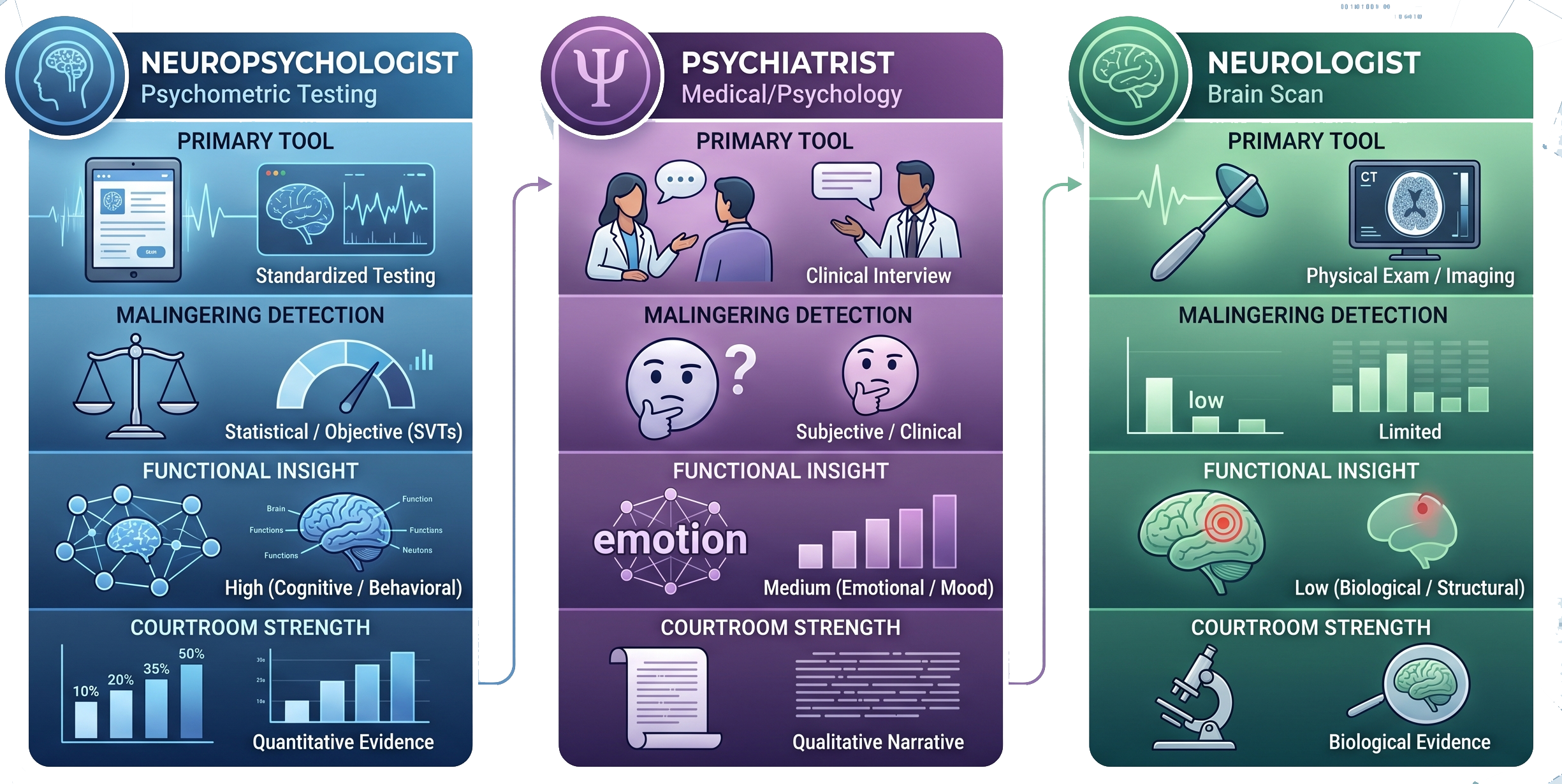
A common misconception in forensics is that psychiatrists and neurologists make better experts because of their medical training. In certain circumstances this might be true; however, in general, neuropsychologists often hold distinct advantages over medical doctors because we rely on objective, standardized measures of functional capacity and symptom validity.
Psychiatrists and neurologists can rely on the results from clinical interviews and physical examinations to prove that an illness or impairment exists, but often the data from cognitive and emotional functioning is more informative for determining the extent to which the illness or impairment might impact past, current and future behavior and decision-making capacity.
Objective Measurement vs. Clinical Intuition
Neuropsychologists are the only professionals who possess the training and credentials to administer and interpret standardized measures of cognitive and emotional functioning. While clinical interviews and physical examinations are very informative to establishing differential diagnoses, we provide empirically-validated measures of cognition on emotional functioning and compare performance to people with similiar demographics, which makes our conclusions more scientifically rigorous under cross-examination.
Functional Impact: The "So What?" Factor
A neurologist can identify a lesion on an MRI, and a psychiatrist can diagnose Depression or PTSD. However, the legal system rarely cares about the diagnosis alone; it cares about functional impairment. Neuropsychologists specialize in explaining how a specific brain injury or illness affects a person’s behavior and daily functioning. The results can also be used to pinpoint where the cognitive circuitry breaks down and predict how it might impact the individual in the future to quantify future functional impairment and devise strategies to overcome limitations.
Detecting Malingering (Symptom Validity)
In litigation, there is often a high incentive for individuals to "fake" or exaggerate symptoms. This is where neuropsychologists typically outshine their medical counterparts. Neuropsychologists rely on specific, embedded, and standalone measures of performance and symptom validity. These tests are designed to detect "sub-optimal effort" or intentional feigning.
Specialization in "Mild" Cases
Neurologists are masters of "hard" signs (e.g., tremors, seizures). However, many legal cases involve mild neurological injuries or illness in which neurological dysfunction is not readily apparent on imaging. Neuropsychological batteries are often sensitive enough to detect cognitive deficits that are "invisible" to medical imaging but still have a devastating impact on person's thoughts, perceptions and behaviors.